
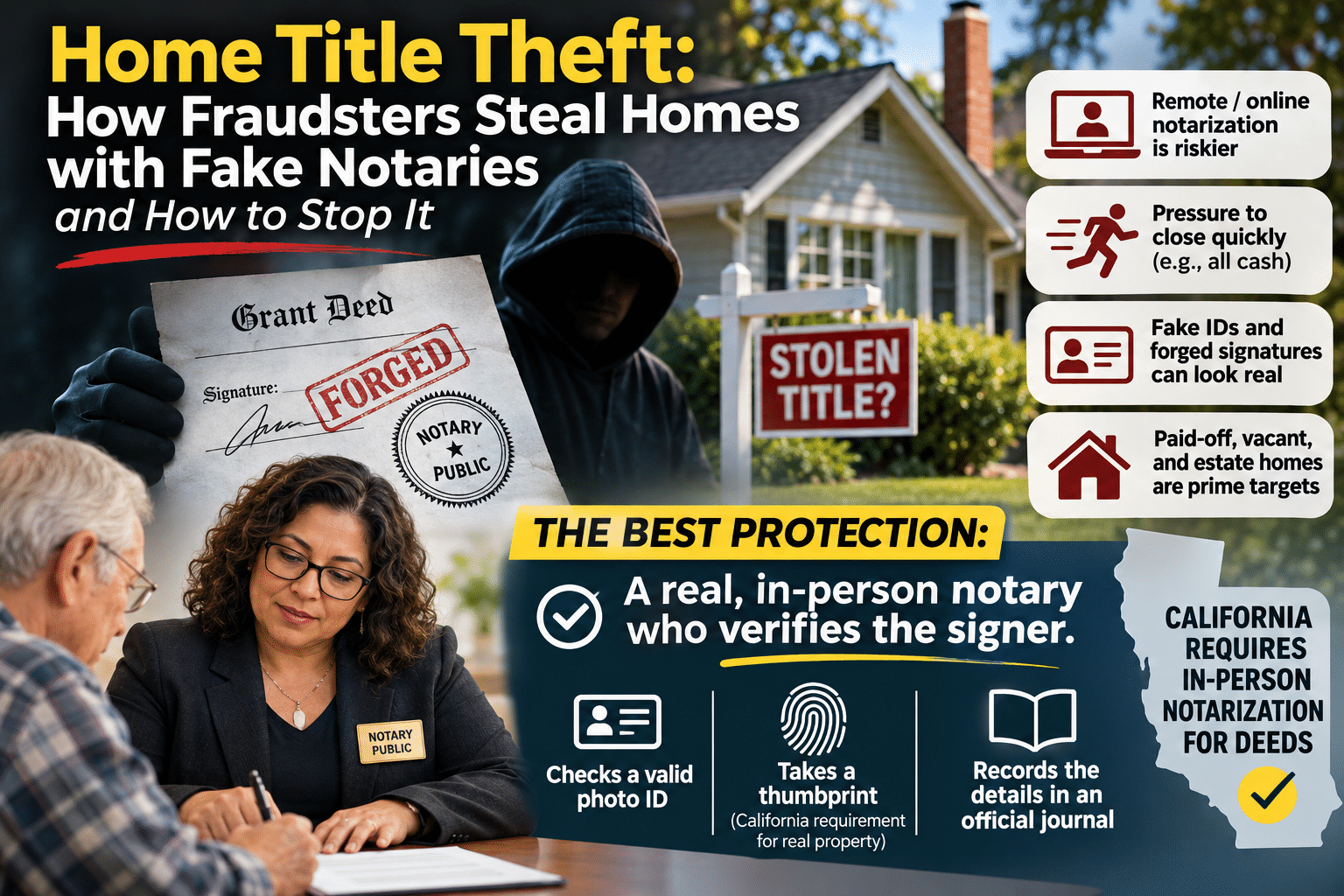
Short answer: Home title theft is one of the fastest growing scams in the country, and a fake or careless notary is often the tool criminals use to pull it off. With a forged signature, a counterfeit notary seal, and a stolen identity, a thief can file a deed that transfers a home they do not own. The best protection is a real, in-person notary who verifies the signer. Here is how the fraud works and how to shut it down.
Most people assume their home is safe simply because they hold the title. The uncomfortable truth is that a deed is just a document, and documents can be forged. When a forged deed gets notarized and recorded with the county, it can look completely legitimate on paper. Families often do not discover the theft until they try to sell, refinance, or settle an estate, and by then the damage is serious. Understanding the notary’s role is key to protecting yourself.
How home title and deed fraud actually works
The scheme is simpler than it sounds. A criminal identifies a property, often one that is paid off, vacant, or owned by an older adult or an estate. They gather enough personal information to impersonate the owner, sometimes using data bought from a breach. They create a fake ID in the owner’s name. Then they prepare a deed transferring the property to themselves or a shell buyer and get it notarized, often pushing for a fast, all-cash closing that discourages questions.
Investigators have described schemes where criminals blast solicitations to dozens of real estate agents at once, sometimes more than sixty in a single hour, hunting for one who will move quickly without verifying the seller. The common thread is speed and pressure. The faster the deal, the less scrutiny the fake identity receives. Notarization is where this should fall apart, because a notary’s job is to confirm the person signing is who they claim to be. When that step is skipped, forged, or handled by a fake notary, the fraud sails through.
Why online and remote notarization raised the stakes
Remote online notarization, where a notary and signer meet only over video, has made many transactions more convenient. It has also created new openings for fraud. In one widely reported case, a scammer used a remote notary to nearly walk away with roughly $75,000 for a plot of land he did not actually own. Deepfakes and sophisticated fake IDs make verifying a face on a screen harder than verifying a person standing in front of you.
This is one of the quiet advantages of California’s current rules. California notaries still cannot perform online notarizations, so every deed and property document here is signed in person. If you want the full picture on where the law stands, read our guide on California estate and probate rules. For high-value documents like a deed, in-person verification isn’t a limitation. It is a safeguard.
What a real notary does that stops fraud cold.
A properly trained, commissioned notary is a verification checkpoint. First, the notary checks a valid, unexpired, government issued photo ID and compares it to the person in front of them. A fake ID is much harder to pass in person than over a webcam. Second, the notary records the act in an official journal, creating a permanent, dated record of who signed, what they signed, and the identification used. Third, and this is specific to California, a notary must take a thumbprint in the journal for any document that affects real property, such as a deed or a deed of trust. That thumbprint is a powerful deterrent, because it ties a real fingerprint to the transaction.
Finally, a careful notary confirms the signer understands what they are signing and is doing so willingly. For an elderly homeowner, that extra moment of attention can catch coercion or confusion before a document is executed. None of this happens when a deed is forged or run through a fraudulent notary stamp bought online. In-person notarization is the step designed to stop title theft.
Red flags that a transaction is not legitimate
Whether you are a homeowner, an heir, or a real estate professional, these warning signs deserve a hard stop. Watch for intense pressure to close quickly, especially all cash deals that avoid a title company or escrow. Be suspicious when a seller refuses to meet in person or insists everything be done remotely. Question any notary who is willing to stamp a document without checking ID, or who offers to notarize a signature that was already signed. Watch for notarizations pushed through for an elderly relative who seems unsure, rushed, or accompanied by someone controlling the conversation. Also watch for requests involving wire transfers, gift cards, or cryptocurrency, which are hallmarks of fraud.
If something feels off, stop. Don’t send money, don’t hand over documents, and verify independently before going further.
How to protect your home and your parents’ home
Protection starts with a few practical habits. Verify any notary’s commission with the California Secretary of State if you have any doubt about their legitimacy. Many counties offer a free property fraud alert that emails you whenever a document is recorded against your address, giving you early warning. Watch especially vulnerable property, including a vacant home, a rental, or a home owned by a parent who has passed or moved into care, because those are prime targets.
Above all, use a trusted, in person notary for anything involving a deed, a trust, or a power of attorney. A power of attorney in the wrong hands can be used to transfer property too, which is why notarizing those documents carefully matters as much as the deed itself. Learn more on our power of attorney notary services page.
What to do if you think a property has been targeted
If you suspect a forged deed or a fraudulent transfer, act quickly. Contact the county recorder’s office where the property is located and ask how to flag a suspicious recording. Report the fraud to your state’s notary regulating authority, which in California is the Secretary of State, and to local law enforcement. If a specific notary was involved, their commission information and journal can become important evidence. The sooner you challenge a fraudulent transfer, the better your chances of unwinding it.
Quick answers about deed and title fraud
Does a notarized deed prove someone owns the property? No. A notarization confirms who signed a document, not that they had the right to sell or transfer the asset. That is exactly why verifying the signer’s identity in person matters.
Is in person notarization really safer than online? For high value documents like a deed, yes. A fake ID and a deepfake are far harder to pull off face to face, and California requires a thumbprint for real property documents.
My parent owns a paid off home. Are they a target? Paid off and vacant homes are among the most common targets. A free county property fraud alert and careful, in person notarization are two simple protections.
Can you come to us for a deed signing? Yes. A mobile notary comes to your home or office, verifies every signer, takes the required thumbprint, and properly records the act.
Why estates and vacant homes are the biggest targets
Not every home is equally at risk. Criminals who commit deed fraud look for properties where the real owner is unlikely to notice a change quickly. That means homes that are paid off, so no lender is watching the title. That includes vacant homes, rental properties, and second homes where no one checks the mail or walks the property regularly. It also includes homes tied to an estate, where the owner has passed away or moved into a care facility and the family has not yet settled affairs. In those situations, a forged deed can sit recorded for months before anyone discovers it. If you are managing a parent’s property, an inherited home, or a rental, treat the title as something that needs active protection. Sign up for your county’s property fraud alert, keep your mailing address current so you receive notices, and use a trusted, in-person notary for any document that transfers or encumbers the property. A parent’s home sitting empty during a hospital stay is exactly the kind of target these schemes hunt for, which is another reason to handle estate paperwork promptly rather than leaving loose ends.
Protect your title with a notary who actually verifies.
Your home is likely the most valuable thing your family owns. Do not trust it to a rushed, remote, or questionable notarization. A real, in person notary is the checkpoint that keeps a forged signature from becoming a stolen home.
Signing a deed, trust, or power of attorney? Book your mobile notary appointment online, and I will come to you in Stockton or anywhere in San Joaquin County, verify every signer in person, and handle it right. Prefer to talk first? Call or text (209) 649-5531.