
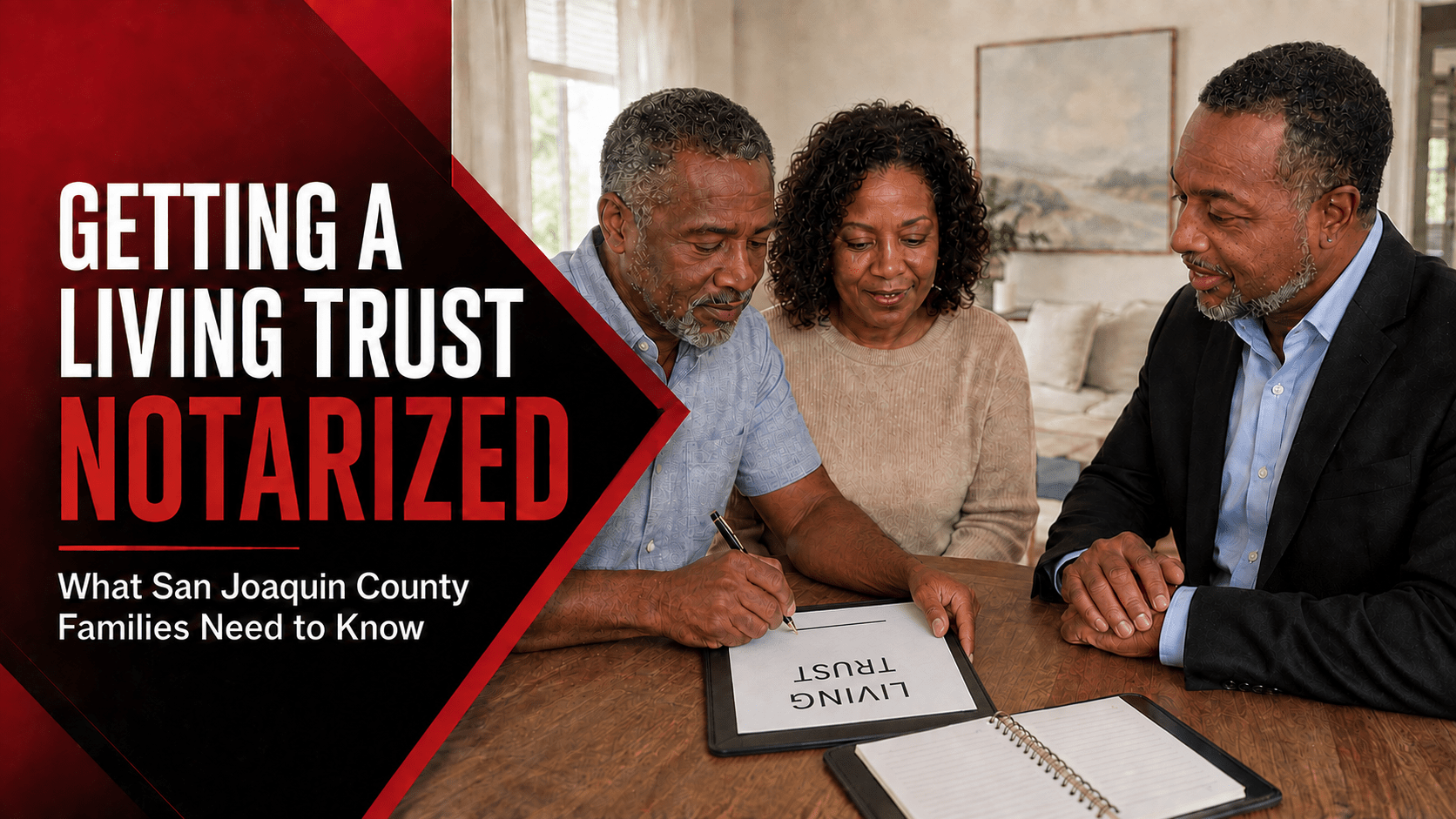
It’s 7:40pm on a Tuesday and Maria’s father just got moved into a room at St. Joseph’s Medical Center after a fall. The attorney finished the living trust paperwork two weeks ago, but nobody got around to signing it. Now everyone in the family is asking the same question at the same time: does Dad need to sign this before surgery tomorrow morning, and if he does, who can actually come to the hospital tonight to witness and notarize it?
This scene plays out across San Joaquin County more often than people expect. A living trust sits finished on someone’s kitchen counter or in an email attachment for weeks, sometimes months, because scheduling a notary during business hours never quite happens. Then a fall, a diagnosis, or a sudden hospital stay turns “we’ll get to it” into “we need this signed tonight.” If you’re in that spot right now, or you want to avoid ending up there, here’s what you actually need to know about getting a living trust notarized in Stockton and the surrounding area.
What a notary actually does with your living trust
A living trust is a legal document your attorney drafts to hold and manage your assets, often to help your family avoid probate court after you pass away or become incapacitated. Once your attorney has prepared the trust and any related documents, like a certification of trust, a pour over will, or a schedule of assets, those documents typically need to be signed in front of a notary public to be valid and accepted by banks, title companies, and county recorders.
Here’s the part that surprises people: a notary is not there to explain what the trust means, tell you which version to sign, or advise you on whether the terms are right for your family. That’s your attorney’s job, and it’s an important one. What a notary does is verify your identity with a valid ID, watch you sign the document willingly and while you’re of sound mind, and then apply a notarial seal and journal entry that makes the signature legally recognized. Think of the notary as the checkpoint that turns a document your attorney wrote into something a bank or the county will actually accept.
As a mobile notary, I bring that checkpoint to you instead of asking you to bring your father, your mother, or yourself to an office. That means hospital rooms, care facilities, jails, and kitchen tables across San Joaquin County, on whatever schedule the situation actually calls for.
Why the timing of notarization matters more than people think
A lot of families treat the notary appointment as the easy, forgettable last step after the “real work” of drafting the trust with an attorney is done. In practice, it’s the step that turns a plan into something enforceable. An unsigned or improperly notarized trust has no legal weight, no matter how carefully it was written. If something happens to a parent or spouse before that signature is notarized, the family can be pushed right back into the probate process the trust was supposed to help them avoid.
This is why I get calls that start with “I know this is short notice, but.” A hospital discharge date moves up. A care facility tells a family that admission paperwork needs a notarized power of attorney or trust document by Friday. A closing on a home sale, meant to fund a trust or settle an estate, is about to fall through because a signature page got missed. In every one of these situations, the document itself was already finished. What was missing was someone available to notarize it on short notice, outside a nine to five window, in a hospital room or care facility rather than a bank lobby.
Common mistakes families make with living trust signings
The single biggest mistake is waiting. Families often sit on a finished trust for weeks because scheduling a notary feels like a small errand that can happen “whenever.” Health does not wait for convenient timing, and neither do closing dates or care facility deadlines. If your attorney has told you the trust is ready to sign, treat that appointment with the same urgency as any other item on a closing checklist.
The second mistake is assuming a hospital or care facility has a notary on staff or on call. Some do, most don’t, and even when one is available, availability is often limited to weekday business hours. If your loved one is admitted on a Friday evening or over a holiday weekend, you may be looking at days of delay unless you know a mobile notary who works outside standard hours.
The third mistake is signing with an expired or mismatched ID. California notaries are required to verify identity with specific forms of ID, and a name that doesn’t match across the trust documents and the ID presented can stop a signing cold. If you’re arranging a signing for an aging parent, it helps to check ahead of time that their driver’s license, state ID, or passport is current and that the name matches what’s on the trust paperwork.
The fourth is forgetting that some documents need more than one signer or more than one witness present at the same time. If your trust package includes a certification of trust, a deed transfer, or a companion power of attorney, all of those pieces may need to be signed in the same session. Confirm with your attorney’s office exactly which documents need notarization so nothing gets left behind when the notary arrives.
What a mobile signing for a living trust actually looks like
When you book a living trust signing with me, the process is straightforward. I confirm which documents need to be signed and notarized, verify that everyone involved has valid, current identification, and set a time that works for the household or facility rather than making you work around a storefront’s posted hours. I’ve handled these signings at kitchen tables, in hospital rooms, in memory care and assisted living facilities, and in jail visiting areas when a family member needed a document signed by someone in custody. On the day of the appointment, I bring my notary seal, journal, and any required paperwork, confirm identities, watch the documents get signed, and notarize on the spot. Most trust signings take well under an hour once everyone is in the room and the paperwork is in order.
I’ve been doing this work for more than 20 years, and I’ve built a track record of more than 180 Google reviews from families and from corporate and attorney clients who needed someone reliable, on time, and easy to reach on short notice. That track record matters most in exactly the kind of situation described at the start of this post: when a family needs a signing handled tonight, this weekend, or before a facility’s deadline tomorrow morning, not whenever the next weekday opening happens to be.
Stockton Mobile Notary offers a simplified, self guided estate planning option for individuals and families who want to create their own living trust without the expense of hiring an attorney. Users complete a detailed intake form that collects the information needed to prepare their trust documents through an easy, organized process. This service is designed for straightforward estate planning needs and does not provide legal advice. Individuals with complex estates, tax concerns, family disputes, or special circumstances should consult a qualified estate planning attorney. Click here to learn more.
When to call
If your attorney has already prepared your living trust and you just need it signed and notarized, don’t wait for a “better time.” Call as soon as the documents are ready, especially if a parent or family member is in a hospital, a care facility, or otherwise not easily able to travel to an office. I offer on-site notarization before and after regular business hours and on weekends specifically because estate planning emergencies don’t check a calendar first.
A quick disclaimer, because it matters: I’m a notary, not an attorney. I can’t tell you which trust document you need, review the terms of your trust, or give legal advice about your estate plan. What I can do is show up where you are and make sure your signatures are properly notarized so your attorney’s work actually holds up when it’s needed. If you don’t yet have an attorney or you’re not sure what your trust package should include, that’s a conversation to have with an estate planning attorney first.
Living trusts are often finished alongside other estate planning paperwork, and if a will, a power of attorney, or an advance medical directive also needs to be signed, we can usually handle everything in a single appointment instead of scheduling separate visits.
Ready to get your living trust signed? Book a Consultation or call 209 649 5531 and we’ll find a time that works, today, tonight, or this weekend.