
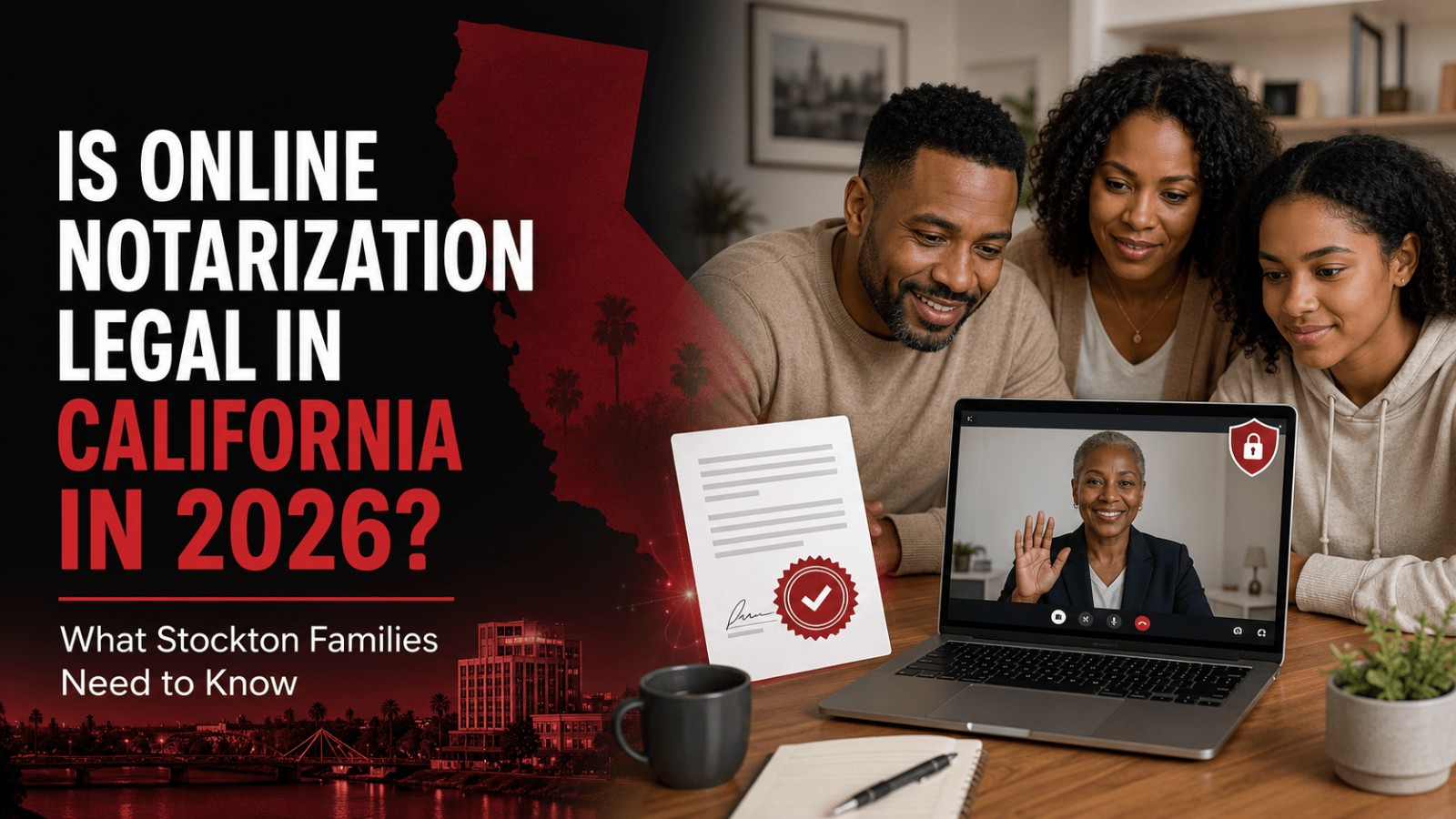
Short answer: No. As of 2026, a California notary still cannot legally notarize your documents online. Every notarization done by a California-commissioned notary must happen in person, face to face. If you need a living trust, a will, a deed, or a power of attorney notarized in Stockton or anywhere in San Joaquin County, you still need a notary physically in the room with you.
This confuses a lot of families, and for good reason. You have probably seen ads for “online notary” services and heard that dozens of states now allow it. So why not California? Here is the full picture, in plain language, so you do not make a costly mistake with an important document.
First, what does “online notarization” even mean?
Online notarization, or remote online notarization (RON), is when a notary and a signer never sit in the same room. Instead, they meet over a live video call. The signer proves who they are through the screen, signs the document electronically, and the notary applies a digital stamp and seal. The whole thing is recorded and stored. Done right, in a state that fully allows it, RON is fast and convenient.
It became popular during the pandemic, when going to an office was hard, and it never went away. Today most states have made it permanent. That is why so many Californians assume they can do it too. The ads do not always make it clear which state’s notary you are actually hiring, and that distinction is the whole ballgame.
What the law actually says
In September 2023, California signed Senate Bill 696, also called the Online Notarization Act. On paper, it allows California notaries to perform remote online notarization, known as RON, using audio and video technology. That sounds like online notarization is legal. But there is a catch that changes everything.
The law is not fully switched on. SB 696 says California notaries can only begin performing online notarizations once the Secretary of State finishes building the technology system required to run the program, or by January 1, 2030, whichever comes first. That system is not finished. So in 2026, no California notary is authorized to notarize anything online. The door is written into law, but it is still locked.
This makes California the last major holdout in the country. Nearly every other state already allows some form of remote online notarization. California, the largest state by population and by the sheer number of documents signed every year, will not have it live until 2030 at the earliest.
Can I just use an online notary from another state?
This is the workaround people ask about most, so let us be straight about it. Yes, you can technically use an online notary who is commissioned in a state like Florida, Texas, or Nevada, where RON is fully legal. If that notary follows their own state’s rules correctly, California will often accept the notarization as valid.
But “often” is the problem when the stakes are high. Here is where families get burned:
First, county recorders and title companies can be picky. If you are recording a deed against California real estate, the recorder may reject an out-of-state electronic notarization, and now your property transfer is stuck.
Second, estate documents have to survive scrutiny years later, often after someone has passed away. If a distant online notary made a small error, you may not find out until the document is challenged in probate court, when it is too late to fix.
Third, no one is in the room with your loved one. When you are signing a living trust for an elderly parent, a good in-person notary can confirm the signer understands what they are signing and is not being pressured. A webcam cannot read a room the way a trained notary sitting across the table can. That protection matters, and it is one of the reasons courts respect in-person notarizations.
What this means for living trusts and estate documents
If you are handling estate planning for yourself or an aging parent in San Joaquin County, this is the part to pay attention to. A living trust only works if it is executed correctly. That means every required signer must sign. Miss one signature and the trust can be treated as invalid. When a mobile notary sits down with your family, they make sure nothing gets skipped.
The ID has to be current. California requires a valid, government-issued photo ID. An expired driver’s license is one of the most common reasons a signing gets delayed or has to be rescheduled. A prepared notary flags this before the appointment, not during it. And the signer must be present and willing. For a trust to hold up, the person signing has to be doing so of their own free will and be aware of what the document is. In-person notarization protects the whole family from a future dispute.
When a trust is invalid, the estate can fall into probate. In California, probate is expensive and slow, often costing families thousands of dollars in fees and dragging on for many months. A properly notarized trust is what avoids all of that. This is exactly why cutting corners with a cheap, faceless online service is a false savings.
Why a mobile notary is still the smart choice in 2026
Since California-commissioned notaries cannot go online yet, the most convenient legal option is a mobile notary who comes to you. Instead of loading an elderly parent into a car and driving to an office, the notary travels to the home, the hospital, the rehab center, or the assisted living facility. The document gets signed where your family already is.
This matters most in the urgent situations that estate documents usually involve. A parent takes a sudden turn and the family needs a power of attorney signed today. A trust has to be finalized before a scheduled surgery. A loved one is in hospice and there is a narrow window to get paperwork done correctly. In every one of those moments, a mobile notary in Stockton can be at the bedside, verify identity, confirm the signer understands, and complete the notarization the same day, fully within California law.
You get the convenience people want from online notarization, without the legal gray area, because a real notary is right there with you.
What a mobile notary appointment actually looks like
If you have never used a mobile notary, the process is simple and quick. You book and tell us the details: what document you are signing, how many signers there are, and where and when you need us. A living trust, a deed, and a power of attorney each have their own signing requirements, so telling us in advance means we arrive fully prepared.
Next, we confirm identity. Every signer shows a valid, unexpired, government-issued photo ID. This is the single most important step. If an ID is expired, we cannot proceed, which is why we remind every client to check theirs before we arrive. Then comes signing and stamping. The signer signs in front of the notary, we complete the notarial certificate, apply the seal, and record the act in our official journal as California law requires. For most signings this takes only a few minutes once we are in the room. No office visit, no waiting room, no moving a fragile parent.
Why hasn’t California caught up yet?
It is a fair question. The answer is that California decided to build its own state-run technology system to handle online notarizations rather than simply approving private platforms overnight. Building and certifying that system takes time, and the law gives the state until 2030 to finish. Until the Secretary of State flips the switch, the safe and legal path for Californians is in person.
The practical takeaway for families is this: do not wait around for 2030 and do not gamble on a shortcut today. If you have a parent whose health is declining, or an estate plan that has been sitting unfinished, the responsible move is to get those documents signed and notarized now, correctly, with a notary who comes to you.
Quick answers to the questions we hear most
Is online notarization legal in California right now? No. Not for California notaries in 2026. It is written into law but does not take effect until 2030 at the earliest.
When will California online notarization start? When the Secretary of State completes the required technology system, or by January 1, 2030, whichever is sooner.
Can I use a notary from another state online? Sometimes it is accepted, but it carries real risk for deeds and estate documents. For anything important, in person is safer.
Do I have to leave my house to get notarized? No. A mobile notary comes to your home, hospital room, or care facility anywhere in San Joaquin County.
What do I need to have ready? A valid, unexpired government photo ID for every signer, and the complete document with no signatures filled in yet.
Need something notarized in Stockton or San Joaquin County?
Do not risk an important document on a service that may not hold up. Stockton Mobile Notary comes to you, at home, at the hospital, or at a care facility, and gets it done right the same day. Call or text today to book your appointment. Tell us what you are signing and when you need it, and we will confirm your time. Fast, reliable, and fully legal in California.