
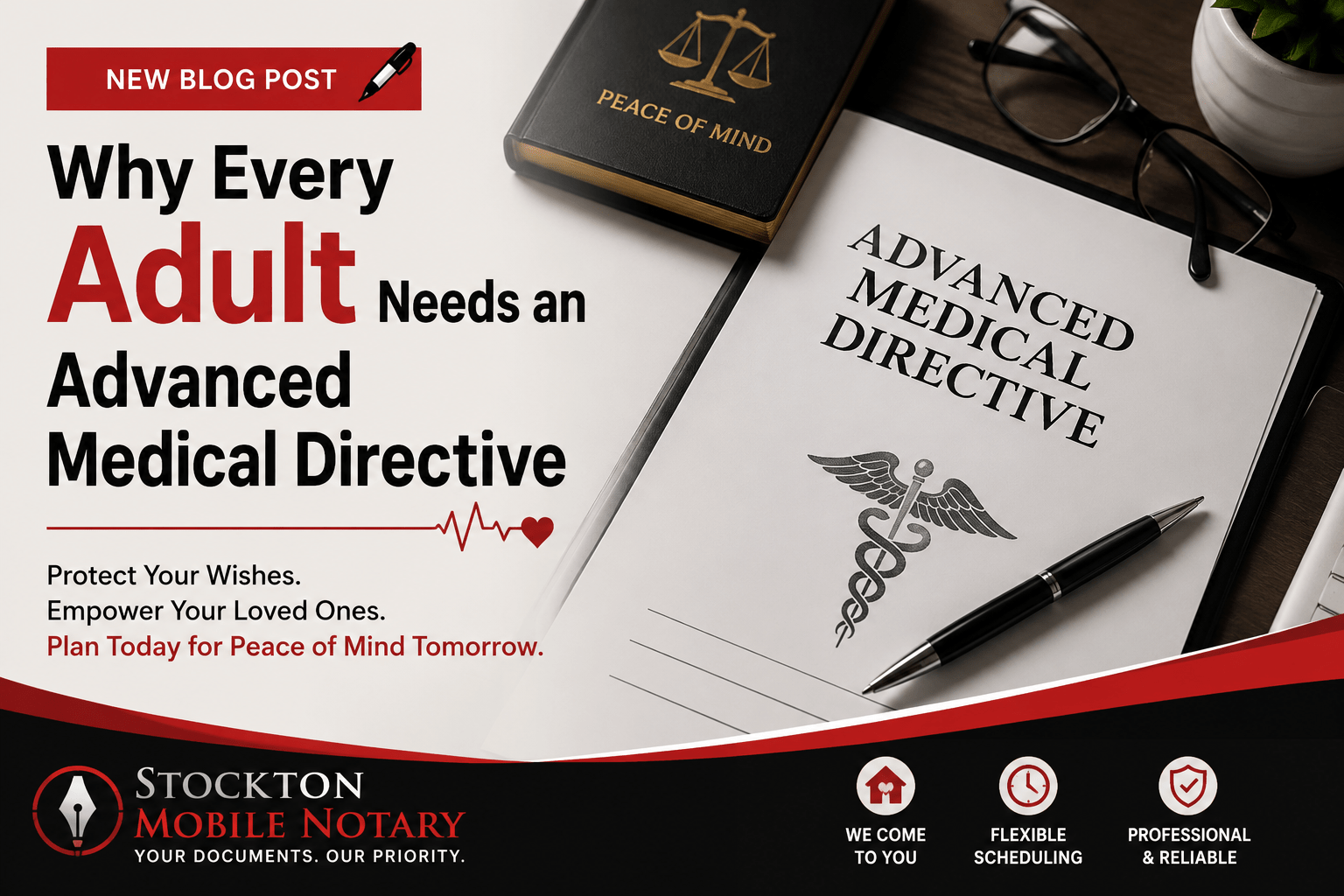
Most people assume that an Advanced Medical Directive is something you think about when you are elderly or seriously ill. That assumption is one of the most dangerous myths in healthcare planning today. The truth is simple: if you are over 18 and breathing, you need one. No exceptions.
An Advanced Medical Directive is a legal document that tells doctors and family members exactly what you want if you become unable to speak for yourself. It covers life support decisions, resuscitation preferences, pain management, organ donation, and who has the legal authority to make medical choices on your behalf. Without it, those decisions are made by strangers, hospital committees, or family members who may disagree, delay, or guess wrong under the worst possible circumstances.
At Stockton Mobile Notary, we have sat at kitchen tables, hospital bedsides, and skilled nursing facilities helping families get these documents signed. We have seen what happens when they exist and what happens when they do not. This post will give you the full picture so you can make a decision today, not when it is too late.
What Is an Advanced Medical Directive?
An Advanced Medical Directive is actually an umbrella term that covers two core documents that work together. The first is a Living Will, which outlines your specific medical wishes in writing. The second is a Durable Power of Attorney for Healthcare, which names a person you trust to make decisions on your behalf when you cannot.
Together, these two documents give the medical team what they need to act quickly and correctly. They eliminate guesswork. They reduce conflict. And they protect the people you love from having to carry the burden of a decision they were never equipped to make alone.
In California, the standard document that combines both functions is called an Advance Health Care Directive. It must be signed in front of two witnesses or notarized to be legally valid. Once signed, it can be filed with your doctor, uploaded to a registry, and carried with you when you travel.
The Top Reasons Adults Put This Off (And Why None of Them Hold Up)
Reason 1: “I’m too young to need one.”
Accidents do not check your age. Car accidents, sudden cardiac events, strokes, and medical emergencies happen to people in their 20s, 30s, and 40s every single day. If you are over 18, you are a legal adult and hospitals are required to treat you as one. Without a directive, no one has legal authority to speak for you, not even your spouse, until a court gets involved.
Reason 2: “My family knows what I would want.”
They may think they do. But knowing what someone would generally want and being legally empowered to enforce it are two very different things. Hospitals require documentation. When family members disagree, which happens more often than you think, the result is delay, legal battles, and decisions made without your input. A written directive cuts through all of that.
Reason 3: “It’s too depressing to think about.”
We understand. This is not a comfortable subject. But think about it this way: creating an Advanced Medical Directive is one of the most loving things you can do for your family. It spares them from having to make an impossible decision in the middle of grief and panic. It is a gift, not a burden.
Reason 4: “I’ll get to it eventually.”
The problem with eventually is that emergencies do not wait. We have received calls from families in crisis who spent hours trying to find a notary while their loved one was in the ICU. By then, the opportunity to plan had already passed. Urgency is always the wrong time to handle something this important.
What Happens When There Is No Directive
This is where reality gets serious. When you arrive at a hospital unconscious or incapacitated without a directive on file, the medical team follows a default protocol. They are legally required to keep you alive using all available means unless they have documentation saying otherwise. That includes ventilators, feeding tubes, CPR, and aggressive interventions you may not have wanted.
Your family will be asked to make decisions on the spot, in a waiting room, in a state of shock. If they disagree with each other, which happens constantly, the hospital may go to a bioethics committee or a court to resolve the conflict. That process takes time you may not have. It costs money. And it causes lasting damage to family relationships.
In California, without a Durable Power of Attorney for Healthcare, the state uses a hierarchy of decision makers that does not always line up with your actual wishes. Your estranged parent could legally outrank your partner of 10 years if you are not married. That is not a hypothetical. That is the law as it stands.
We have worked with families who had to call attorneys in the middle of the night to establish guardianship just to authorize a surgery. All of that pain could have been avoided with a single document signed in advance.
What Your Directive Should Cover
A strong Advanced Medical Directive addresses the following areas clearly and specifically.
Life sustaining treatment: Do you want to be kept alive on machines if there is no reasonable chance of recovery? Under what conditions do you want treatment continued or withdrawn? These are the core questions your document must answer.
Resuscitation preferences: A Do Not Resuscitate order can be included in your directive. This tells first responders and hospital staff your wishes regarding CPR and cardiac interventions. Without it, resuscitation is automatic.
Artificial nutrition and hydration: If you are in a permanent vegetative state or have a terminal condition, do you want to be kept alive via feeding tube? Your document should address this directly.
Pain management and comfort care: Even if you choose to decline aggressive treatment, you can specify that you want maximum comfort care and pain relief. This is sometimes called palliative care directives, and they are just as important as the treatment refusals.
Organ and tissue donation: Your directive is the right place to document your donation wishes so your family is not left making that decision in the moment.
Your healthcare agent: This is the person you name to speak for you. Choose someone who is calm under pressure, understands your values, and will follow your instructions even when other family members push back. Being someone’s healthcare agent is a serious responsibility and the person you choose should know they have been selected and what you expect of them.
How to Get It Done
The process is simpler than most people expect. California provides a free standardized Advance Health Care Directive form through the state Attorney General’s office. You fill it out, name your healthcare agent, answer the key questions about your wishes, and then sign it properly.
To be legally valid in California, your signature must be witnessed by two adults who are not your healthcare agent, not related to you by blood or marriage, and not entitled to inherit from your estate. Alternatively, you can have the document notarized instead of witnessed. Notarization provides the strongest level of legal protection and is the preferred method when the document needs to be accepted across state lines or in multiple healthcare systems.
This is exactly what we do at Stockton Mobile Notary. We come to you. Whether you are at home, in a hospital, at a care facility, or in assisted living, we bring the notary to your location at a time that works for your schedule. We handle estate planning signings every week and we understand the urgency these documents carry.
Once signed, make copies. Give one to your healthcare agent, one to your primary care physician, one to any specialist treating a serious condition, and keep the original somewhere accessible at home. Consider uploading it to the California Advance Health Care Directive Registry, so it is available to any hospital in the state.
Sometimes signing a directive is the moment a family realizes a bigger decision is coming, like where a parent will live after a hospital stay. When that day arrives and you need urgent senior placement in San Joaquin County, we help families arrange safe assisted living or memory care quickly, at no cost to the family.
This Is About Control, Not Death
Here is the reframe that changes how most people think about this. An Advanced Medical Directive is not about preparing to die. It is about staying in control of your own life even when you cannot speak. It is about making your voice the loudest one in the room when it matters most.
Every day you go without one is a day your medical decisions are left to chance, to conflict, or to a system that does not know you. You have worked hard to build your life. You have opinions, values, and preferences that matter. This document is how you protect them.
If you are ready to get your Advance Medical Directive signed today, we are ready to come to you. Our mobile notary team serves San Joaquin County and the surrounding areas with same day and next day appointments available for estate planning and healthcare document signings.
Call us or book online at StocktonMobileNotary.com. Do not wait for a crisis to start planning. The best time to sign this document is right now, before you ever need it.
Stockton Mobile Notary provides professional mobile notary services for healthcare directives, living trusts, estate planning documents, and more throughout San Joaquin County. We bring the notary to you.